
Open Source AI vs Big Tech AI: Who Actually Controls Your Assistant?
Hermes and OpenClaw vs ChatGPT, Claude, and Grok. The real difference isn't intelligence — it's who holds the keys.
Here's a question nobody asks until it's too late: who controls your AI?
Not "which AI is smartest." Not "which one writes the best email." The real question — the one that matters when your business depends on it — is: when something changes, do you get a say?
Let me break this down.
The two worlds of AI
Right now there are two completely different ways to use AI, and most people only know about one.
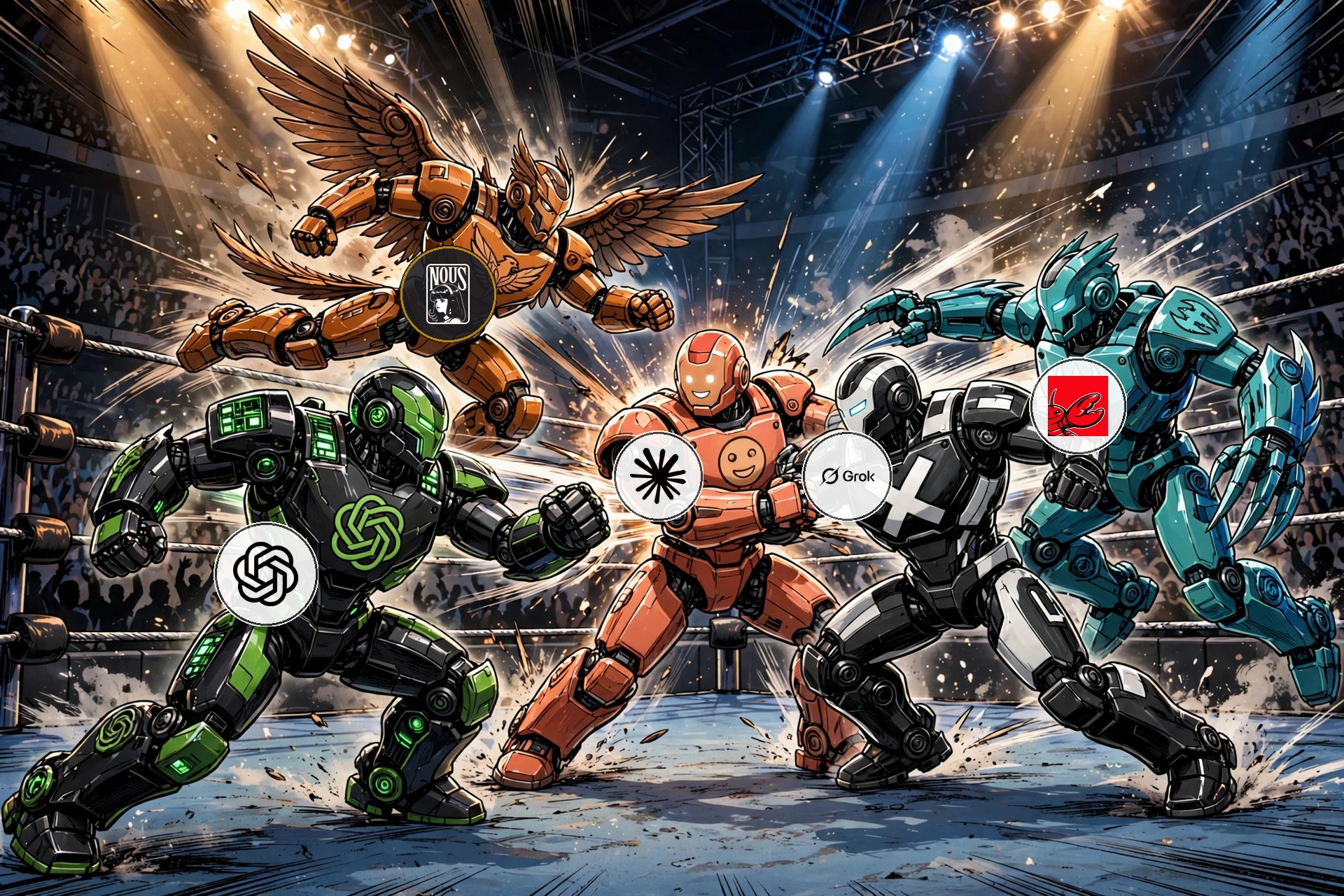
World one: the rented assistant. ChatGPT, Claude, Grok. You open an app, you type, it answers. It's polished, it's powerful, it works great. But you're a tenant. You're renting space in someone else's building. They set the rules, they set the price, and they can renovate the whole place overnight without asking you.
World two: the owned workshop. Hermes (from Nous Research) and OpenClaw. Open-source AI agent frameworks that run on your machine, your server, under your rules. You pick the brain (the language model), you decide what it can touch, and your data never leaves your building.
Same AI revolution. Completely different power dynamic.
What Hermes and OpenClaw actually are
Forget the hype for a second. Here's what these things do in plain English.
OpenClaw started as a weekend project by an Austrian developer and became one of the fastest-growing open-source projects ever — hundreds of thousands of GitHub stars. It's a framework that turns any language model into an autonomous assistant that lives on your hardware. It connects to WhatsApp, Telegram, Slack, Signal — the apps you already use — and can actually do things: read files, run commands, browse the web, manage your calendar, send emails. Not just chat. Act.
Hermes Agent (from Nous Research, the folks behind the Hermes open model family) takes it further with a self-improving loop. When it completes a task, it writes down what it learned as a reusable "skill." Next time, it's faster. It remembers across sessions. It builds a picture of how you work. And it runs on your infrastructure — a cheap VPS, your laptop, wherever you want.
Both are MIT-licensed. That means you can read every line of code, modify it, and nobody can take it away from you.
Where the control actually lives
This is the part that matters. Let me lay it out straight.
Your data. With ChatGPT or Claude, every message goes to their servers. Every document you upload, every question you ask — it lives on their infrastructure under their privacy policy. With Hermes or OpenClaw running locally, your data stays on your machine. The only thing leaving your network is the API call to whatever model you chose — and you can even eliminate that by running a local model.
Your model, your choice. Don't like how GPT-5 handles your tasks? Too bad — that's what you get. With open frameworks, you swap models like changing a lightbulb. Use Claude today, try an open model tomorrow, run something local next week. One command and you're on a different brain. Try doing that with a ChatGPT subscription.
No surprise changes. OpenAI changes its pricing? Anthropic deprecates a feature you depend on? xAI puts your favorite Grok capability behind a higher tier? You adapt or you leave. With open source, the code is yours. Nobody pushes an update that breaks your workflow at 2 AM.
Real automation, not chat. Here's what most people miss: ChatGPT and Claude are fundamentally conversational. You ask, they answer. Hermes and OpenClaw are agentic — they take actions across your systems on a schedule, without you prompting them. Morning briefing in your Telegram? Done. Inbox triage while you sleep? Done. That's a different category of tool.
Inspectability. When your AI does something weird — and it will — would you rather read the code or file a support ticket? With open source, you (or your developer) can trace exactly what happened. With closed systems, you're guessing.
What you give up (let's be honest)
I'm not going to pretend open source is free lunch. Here's the real cost.
Setup is on you. ChatGPT takes 30 seconds to start using. OpenClaw or Hermes takes real setup — a server, configuration, model API keys. If you're not technical, you'll need someone who is. That's literally what I do, by the way.
You're the IT department. When something breaks at midnight, there's no support hotline. There's GitHub issues and Discord communities — which are actually great — but you're responsible.
The polish gap. Big Tech AI products are smooth. The UI, the mobile apps, the integrations — billions of dollars went into that experience. Open-source tools are powerful but rougher around the edges. This gap is closing fast, but it's real today.
You pay for compute. No subscription doesn't mean no cost. You're paying for the model API calls or the hardware to run local models. For most business use cases this is still cheaper than enterprise AI plans, but it's not zero.
So which should you pick?
Here's my honest take:
Stick with ChatGPT, Claude, or Grok if: you want something that just works, you don't handle sensitive data, and you're fine with the subscription model. For casual use, brainstorming, and general productivity — they're excellent. No shame in it.
Go open source with Hermes or OpenClaw if: you handle client data, proprietary information, or anything you'd be uncomfortable sending to a third party. If you want automation that runs while you sleep. If you want to swap models without rebuilding everything. If the idea of a company changing the rules on you keeps you up at night.
The smart play for most California businesses? Both. Use the polished closed tools for quick tasks and brainstorming. Run open-source agents for the stuff that touches your real operations — client communications, document handling, scheduled workflows. That's where control matters most.
The bottom line
The AI race isn't just about who's smartest. It's about who holds the keys.
Closed AI gives you convenience. Open AI gives you control. And in business, control over your tools, your data, and your workflows isn't a nice-to-have — it's the whole game.
The companies that figure this out early — that build on foundations they actually own — are going to have a massive advantage over the ones renting everything and hoping the landlord stays friendly.
Don't hope. Own.
Want help setting up your own AI infrastructure? Talk to me — I build systems businesses actually control.
🌳 The Short Version
open-vs-closed-ai/
├── closed-ai/
│   ├── chatgpt-claude-grok.md (polished, convenient)
│   ├── your-data-on-their-servers.md
│   ├── they-set-rules-and-prices.md
│   └── conversational-not-agentic.md (ask, answer, repeat)
├── open-ai/
│   ├── hermes-openclaw.md (MIT licensed, your hardware)
│   ├── your-data-stays-yours.md
│   ├── swap-models-freely.md (one command, new brain)
│   ├── real-automation.md (acts while you sleep)
│   └── inspect-everything.md (read the code, not a ticket)
├── tradeoffs/
│   ├── setup-is-on-you.md
│   ├── no-support-hotline.md (but great communities)
│   └── less-polish.md (closing fast)
└── takeaway/
    └── dont-hope-own.md (control is the whole game)