

AI and SEO: What Actually Works (And What Will Wreck Your Rankings)
California business owners: AI can supercharge your SEO or tank it. Here's the honest breakdown of what works, what doesn't, and how to not get burned.

Let me be straight with you.
Half the business owners I talk to in California are either terrified of AI or think it's a magic button that'll put them on page one of Google overnight. Both groups are wrong. And both groups are leaving money on the table.
I've been doing SEO long enough to watch every "game changer" come and go. AI is different — not because it's magic, but because it's a really powerful tool that most people are using wrong.
Here's the honest breakdown.
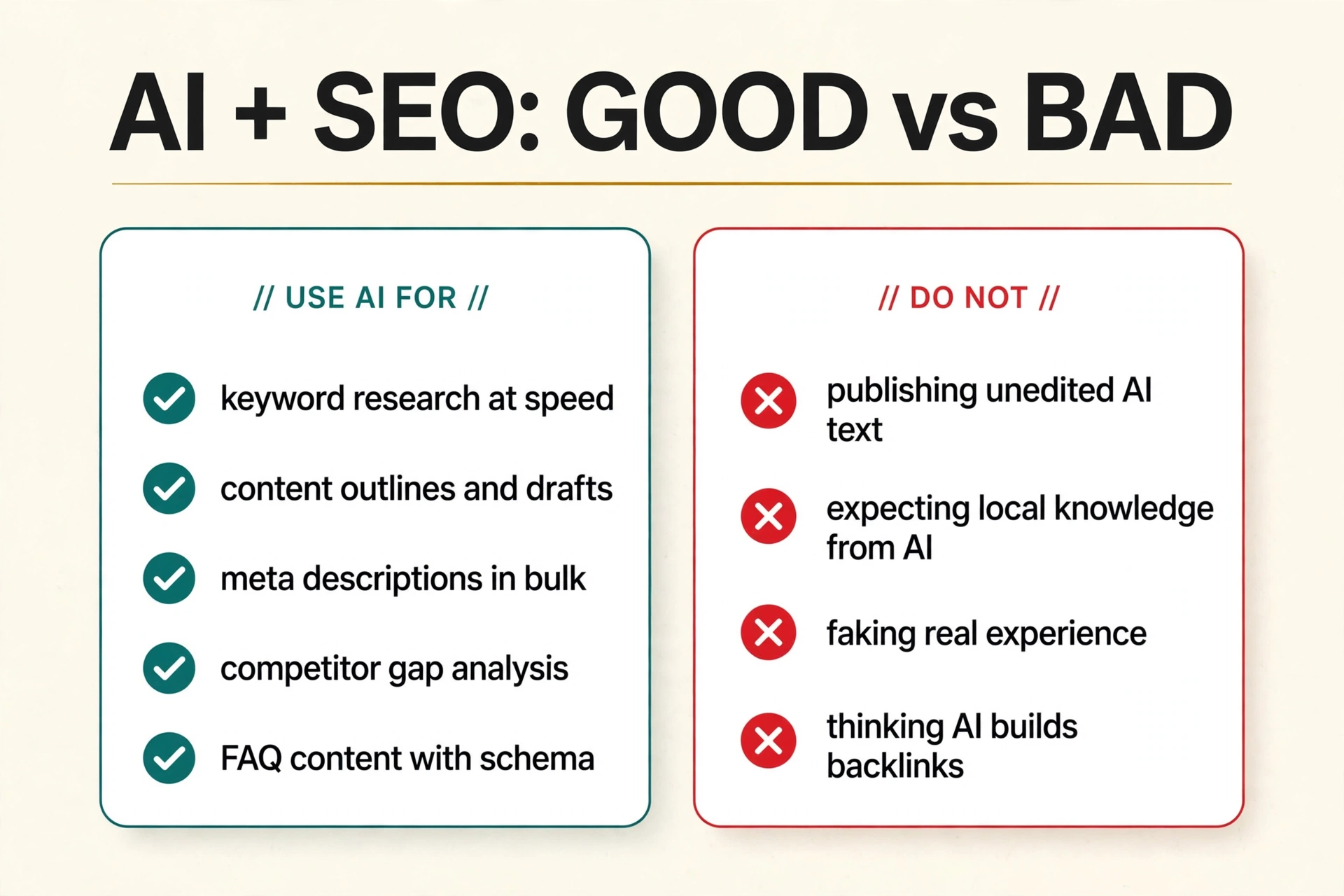
What AI is actually great at for SEO
Keyword research at speed. What used to take me a full afternoon, AI does in ten minutes. Feed it your business type and city, ask for search intent variations, and you get a solid starting list. It's like having an intern who never sleeps and reads fast.
Content outlines and first drafts. Staring at a blank page? AI kills that problem. Give it your topic, your audience, and your key points — it gives you a structure to work with. Not a finished article. A starting point.
Meta descriptions and title tags. The boring, repetitive stuff. AI is perfect for cranking out 50 meta descriptions that are actually decent. This is the unsexy work that moves the needle.
Competitor analysis. "What are the top three plumbers in Riverside ranking for that I'm not?" AI can chew through that data fast and spot gaps you'd miss scrolling manually.
FAQ content. Your customers ask the same ten questions. AI helps you turn those into proper FAQ sections with schema markup. Google loves this. Customers love this.
What AI is terrible at (and will hurt you)
Publishing AI content without editing it. This is the big one. Google doesn't penalize AI content specifically — it penalizes bad content. And raw AI output is usually generic, vague, and sounds like everyone else's website. If your "About Us" page reads like a robot wrote it, that's because a robot wrote it and you didn't fix it.
Local knowledge. AI doesn't know that Temecula's wine country crowd searches differently than San Diego beach businesses. It doesn't know your neighborhood, your customers, or why someone picks you over the guy three blocks away. That part is still yours.
E-E-A-T signals. Google wants Experience, Expertise, Authoritativeness, and Trust. AI has none of these. It hasn't fixed a single AC unit in 110-degree Palm Springs heat. You have. That real experience is your edge — don't let AI wash it out.
Building actual authority. Backlinks, citations, reviews, community presence — AI can't do any of this for you. It can't join your local chamber of commerce or get you mentioned in the neighborhood Facebook group.
How not to get burned: the rules
Rule 1: AI drafts, you decide. Never publish something you haven't read, edited, and improved. If you wouldn't put your name on it, don't put it on your website.
Rule 2: Add what AI can't. Your stories, your photos, your customer reviews, your specific local knowledge. This is what separates your page from the 500 other AI-assisted pages targeting the same keyword.
Rule 3: Don't chase volume. Publishing 100 thin AI articles is worse than publishing 10 great ones. Google's been clear about this. One page that actually answers a customer's question beats fifty pages of fluff.
Rule 4: Keep your Google Business Profile human. Your GBP is often the first thing people see. The posts, the Q&A, the review responses — a real human voice here builds trust that AI can't fake.
Rule 5: Measure, don't guess. Set up Search Console (it's free). Watch which pages get impressions and clicks. If an AI-assisted page isn't performing after 60 days, rewrite it with more of you in it.
The workflow that actually works
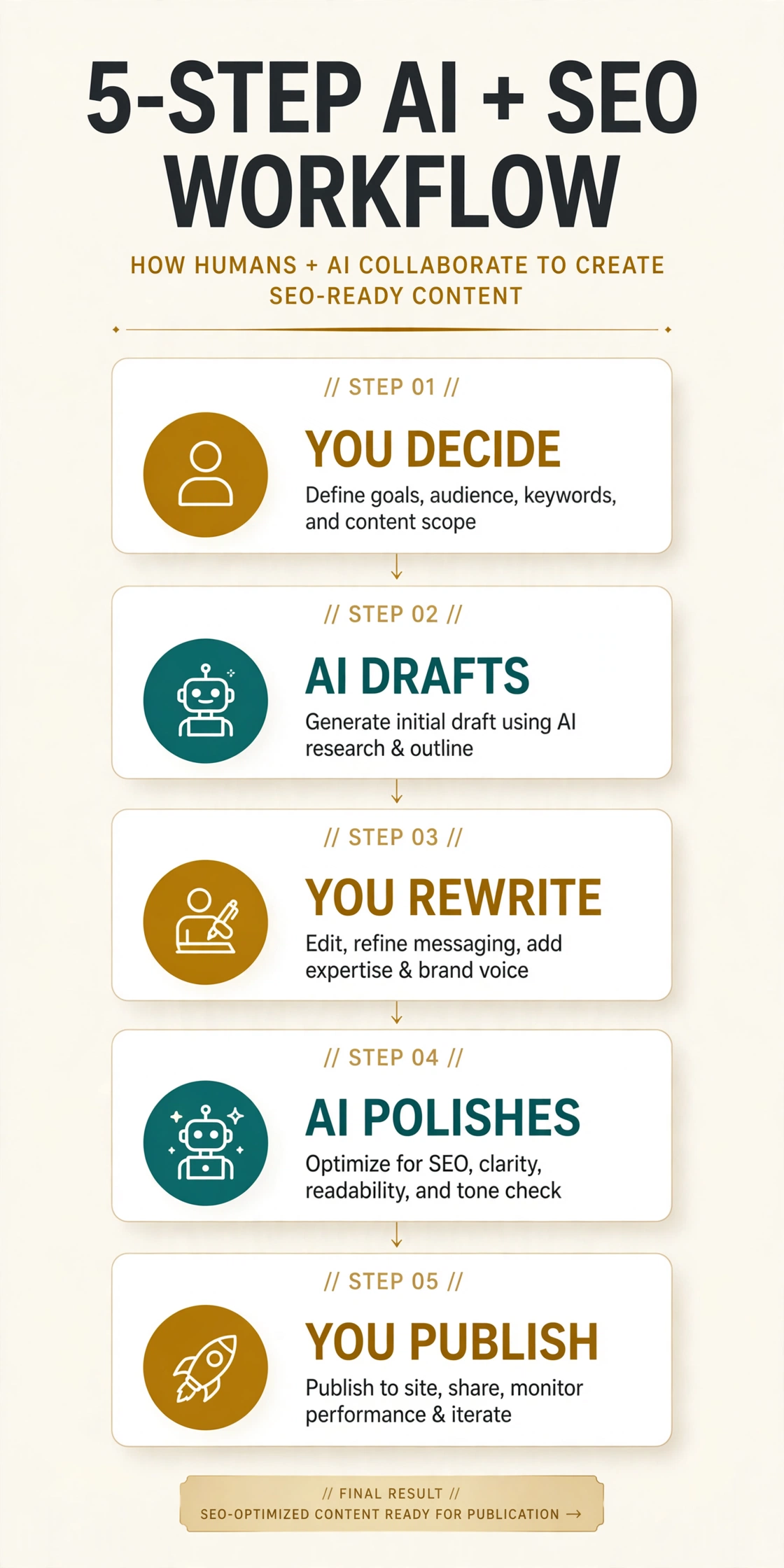
Here's what I tell every California business owner:
- You decide the topic based on what customers actually ask you
- AI generates an outline and a rough first draft
- You rewrite it with real examples, local details, and your personality
- AI helps polish — grammar, meta description, FAQ schema
- You publish and track it in Search Console
Think of AI like a really good sous chef. It preps the ingredients fast. But you're still the head chef. The dish has your name on it.
The bottom line
AI won't replace good SEO. But good SEO people using AI will absolutely replace the ones who aren't.
The California businesses winning at this right now aren't the ones with the fanciest AI tools. They're the ones combining AI speed with real human expertise — actual experience, actual local knowledge, actual personality.
Don't be scared of it. Don't worship it. Use it like the tool it is.
And for the love of everything — read what it writes before you hit publish.
Want help getting your SEO sorted? Get a free marketing audit and I'll tell you exactly where you stand.
🌳 The Short Version
ai-seo-guide/
├── what-ai-does-well/
│   ├── keyword-research.md (10 min, not 4 hours)
│   ├── outlines-and-drafts.md (starting point, not finished)
│   ├── meta-tags.md (boring work, done fast)
│   └── competitor-gaps.md (spots what you miss)
├── what-ai-sucks-at/
│   ├── unedited-content.md (generic, hurts rankings)
│   ├── local-knowledge.md (doesn't know your neighborhood)
│   └── real-authority.md (can't build backlinks or trust)
├── rules/
│   ├── ai-drafts-you-decide.md
│   ├── add-what-ai-cant.md (your stories, photos, reviews)
│   ├── quality-over-quantity.md (10 great > 100 thin)
│   └── measure-everything.md (Search Console, 60-day check)
└── takeaway/
    └── sous-chef-not-head-chef.md (AI preps, you cook)